
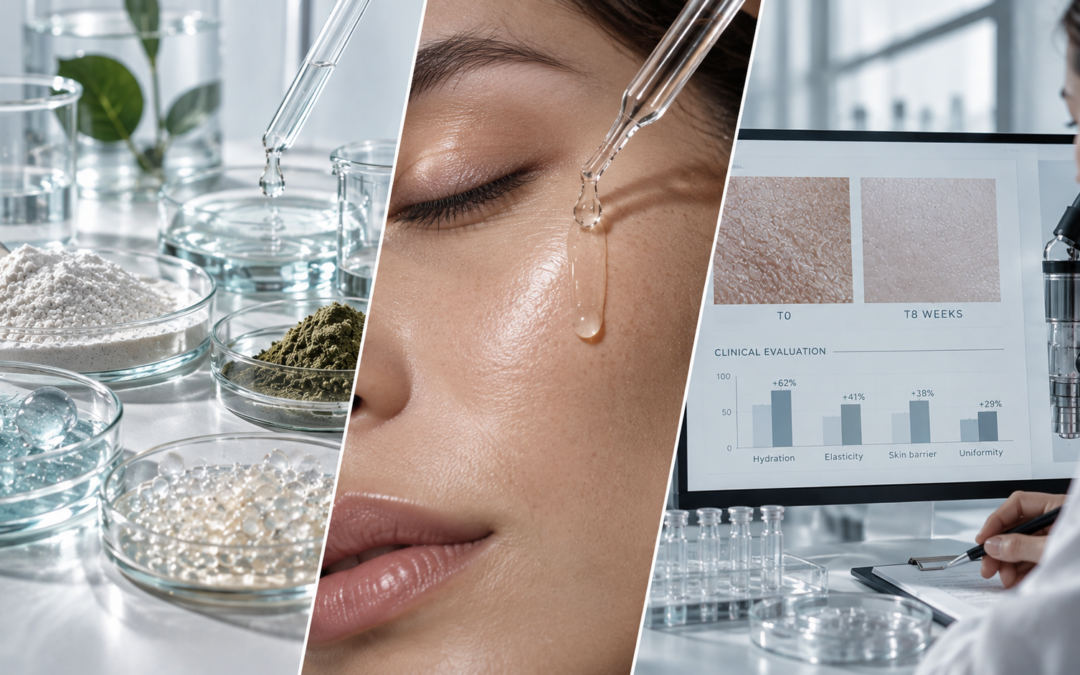
Cosmetic Ingredients: What Really Determines the Efficacy of an Active Ingredient
Choosing the cosmetic ingredients for a formula should not be limited to including active ingredients that are currently trending or those that are best known to consumers.
Retinoids, peptides, vitamin C, hyaluronic acid, ceramides, PDRN, exosomes, or niacinamide can add significant value to a dermocosmetic product. However, the mere presence of an active ingredient in the INCI list does not guarantee that a formula will deliver the expected results.
Actual efficacy depends on multiple factors: the quality of the ingredient, the available evidence, its concentration, its stability within the formula, its compatibility with other components, its tolerability, and, especially, the way in which that active ingredient is delivered.
That is why, when a brand develops a new cosmetic product, the question should not be solely which active ingredients we want to include, but how we should formulate them so that they can reach their full potential.
What are active ingredients in cosmetics?
Cosmetic active ingredients are substances incorporated into a formula to serve a specific functional purpose on the skin, hair, or their associated structures.
Depending on the product, they may be designed to improve aspects such as:
- hydration
- brightness
- color uniformity
- firmness and elasticity
- barrier function
- skin texture
- comfort
- appearance of lines and wrinkles
- regulating excess sebum
- protection against oxidative stress
However, not all ingredients in a formula necessarily have the same functional significance.
A cosmetic formulation also includes carriers, humectants, emollients, stabilizers, texture modifiers, preservatives, and other components necessary to create a stable, safe, and pleasant-to-use system.
A cosmetic ingredient is not effective simply because it appears on the INCI list
One of the most common oversimplifications in the cosmetics market is to judge a product solely based on its list of ingredients.
Finding a well-known ingredient on the INCI list may be appealing from a commercial standpoint, but it provides limited information about how the formula actually performs.
To properly evaluate the potential of a cosmetic ingredient, it is necessary to analyze, among other factors:
- the concentration used
- the quality and characteristics of the raw material
- the chemical form of the ingredient
- its stability
- the pH of the formula
- possible incompatibilities
- synergies with other components
- the vehicle system
- tolerability
- the final cosmetic form
Therefore, two products that appear to contain the same active ingredients may behave very differently.
Formulation is what transforms a selection of ingredients into a truly effective dermocosmetic product.
1. Scientific evidence: What do we really know about the active ingredient?
Before adding an ingredient to a formula, it is advisable to assess the level of evidence supporting its use.
Not all raw materials are supported by the same level of scientific documentation.
The information may come from various sources:
- published studies on the ingredient itself
- studies conducted by the raw material supplier
- in vitro experiments
- ex vivo studies
- clinical or instrumental trials
- studies on the use of the finished product
Each type of evidence provides different information.
For this reason, in dermocosmetic development, it is important to distinguish between evidence regarding an active ingredient and evidence regarding the finished product.
2. Concentration: More doesn’t always mean better
The percentage of certain ingredients has become a highly visible marketing selling point.
It is common to find products that feature high concentrations of niacinamide, vitamin C, acids, retinoids, or other active ingredients.
However, increasing the percentage of an ingredient does not necessarily mean that the product’s effectiveness will increase proportionally.
Each asset has:
- a range of uses
- a technically sound concentration
- certain conditions of stability
- a tolerability profile
- a specific relationship with the rest of the formula
An excessively high concentration can even hinder the development of a good formulation, affect sensory properties, increase the risk of intolerance, or compromise stability.
The right question is not what is the highest percentage we can use, but rather, what is the appropriate concentration within this formula to achieve our goal.
3. Stability: A good asset should continue to perform within the formula
Some cosmetic ingredients are particularly sensitive to factors such as:
- light
- oxygen
- temperature
- pH
- water
- certain electrolytes
- interaction with other ingredients
Incorporating a technically interesting component does not add value if it subsequently degrades, loses stability, or alters the product’s performance.
For this reason, during the development of a cosmetic product, both the stability of the formula and the compatibility of its ingredients must be evaluated.
Seemingly simple aspects, such as packaging, can also be decisive.
An oxidation-sensitive ingredient, for example, may require specific formulation conditions and packaging that limits its exposure to air or light.
Effectiveness begins long before the cosmetic product is applied to the skin.
It starts with the design of the formula itself.
4. Compatibility and Synergy Among Cosmetic Ingredients
Another common trend is to try to include a large number of recognizable ingredients in a single product. But a long list of ingredients does not necessarily mean a better formula.
The active ingredients must be compatible with each other and with the rest of the formulation. In addition, some combinations may be particularly beneficial because their mechanisms or benefits complement each other to create a coherent formulation architecture.
In advanced dermocosmetics, synergy is often more important than quantity.
5. Vehicle Integration: The Factor That Many Brands Overlook
This is one of the most important aspects of formulation development: the delivery of active cosmetic ingredients.
An asset must be integrated into a system capable of keeping it stable and ensuring it reaches the correct destination so that it can function as intended.
The vehicle is not merely the medium in which the ingredient is contained. It is an integral part of the formula’s efficacy design.
It can affect:
- asset dispersion
- its stability
- his release
- its availability
- interaction with the skin surface
- sensory experience
- tolerability
- the product’s final performance
That’s why, at Carmado Labs, we advocate a very simple idea:
An asset doesn’t work just because it’s in the formula.
Our formulation approach integrates this logic into our exclusive Efficacy System™, a proprietary system based on the design of active ingredient delivery systems to create formulas that are more effective, stable, and aligned with the product’s intended purpose.
Choosing the ingredient is just the beginning.
6. The cosmetic formulation also affects the result
Serum, emulsion, gel-cream, balm, solution, oil, mask, or ampoule are not simply different formats from a commercial standpoint.
Cosmetic form influences:
- the addition of certain ingredients
- the highest possible concentration
- stability
- the liberation
- sensory experience
- usage profile
- the consumer experience
An active ingredient may require a specific lipid environment, a particular aqueous phase, or a specific emulsion architecture.
For this reason, the choice of cosmetic form should be made in conjunction with the formulation process, rather than as a subsequent aesthetic decision.
7. Tolerance: An effective formula must be usable
There is another common mistake: designing exclusively to maximize intensity without giving sufficient consideration to tolerance.
A formula may contain excellent ingredients, yet still fail if it creates an uncomfortable experience or cannot be used as often as intended.
Tolerance is especially important when working with:
- retinoids
- alpha and beta hydroxy acids
- certain antioxidants
- depigmenting agents
- high concentrations of functional ingredients
- formulas designed for sensitive skin
In many cases, improving effectiveness does not mean becoming more aggressive.
It means finding the right balance between activity, formulation, frequency of use, and tolerance.
8. Sensory Experience: Science and User Experience Must Work Together
Sensory qualities may seem like a purely commercial consideration, but they have a direct influence on consumer behavior. Texture, absorption, spreadability, finish, and compatibility with other products are also key factors in the development of an effective cosmetic product.
A technically excellent formula that feels heavy, sticky, or uncomfortable, causes peeling, or is difficult to incorporate into a routine is more likely to be abandoned, and a product that isn’t used consistently is unlikely to deliver its maximum performance.
In dermocosmetics, efficacy and user experience should be considered common goals.
Trending Assets: Innovation, Yes—But With Discernment
Every year, new ingredients and technologies emerge and quickly gain visibility in the market.
In recent years, concepts such as:
- PDRN
- exosomes
- peptides
- retinal
- biomimetic factors
- postbiotics
- advanced ceramides
- spicules
They have gained increasing prominence, which can open up interesting opportunities for brands, but incorporating an ingredient simply because it is growing in popularity does not guarantee a product that stands out.
Before investing in an emerging market asset, it’s a good idea to ask yourself:
- Is there sufficient evidence?
- Does it make sense for the product’s purpose?
- Can we use it under technically suitable conditions?
- Does it offer something different compared to other options?
- Can we build a solid product case around it?
Formulation innovation does not mean chasing after every new ingredient that appears on the market.
It involves identifying which ones have real potential and knowing how to use them.
How should a cosmetics brand choose its ingredients?
A brand should not begin the development process by drawing up a list of desired ingredients.
The process should start earlier.
1. Define the product’s objective
What do we want to achieve?
Hydration, radiance, firmness, barrier repair, texture improvement, even skin tone, and sebum regulation each require different formulation strategies.
2. Define the consumer and the context of use
The formulation is different for sensitive skin than for an intensive professional regimen.
Designing a product for everyday use is not the same as designing a one-time treatment, either.
3. Select assets that are meaningful in terms of formulation
The ingredients must be appropriate for the product’s intended purpose and supported by sufficient evidence and technical documentation.
4. Define concentration, formulation, and vehicle
This is where laboratory experience takes on special importance.
5. Verify stability, compatibility, and security
The formulation must retain its properties throughout its entire expected service life.
6. Formulate claims that are consistent with the available evidence
Marketing and science must move forward together.
First, there must be a solid concept. Then the story is developed.
The Role of the Cosmetics Laboratory in Ingredient Selection
When a brand works with a laboratory that specializes in dermocosmetic development, it should receive more than just a list of available raw materials.
The laboratory must be able to provide:
- formative knowledge
- technical evaluation of assets
- selection of concentrations
- compatibility study
- vehicle design
- stability control
- sensory evaluation
- regulatory support
- industrial scaling
Because developing a cosmetic product isn’t just about throwing together appealing ingredients.
It involves building a formulative system that functions as a whole.
Beyond the Ingredient: Designing Formulas Based on True Logic of Efficacy
Consumers are becoming increasingly familiar with cosmetic ingredients and are demanding greater transparency regarding the formulas used.
This presents an opportunity for brands, but it also raises the bar.
It’s no longer enough to just hire the right person.
It is necessary to select the appropriate raw material, use it under consistent conditions, maintain its stability, combine it properly, and design a vehicle that allows its potential to be fully realized.
At Carmado Labs, we apply this vision to the development of every project: combining expert formulation, clinical experience in medical aesthetics, and advanced knowledge of delivery systems to transform ingredients into effective, stable, and unique dermocosmetic formulas.
Because the value of an ingredient lies not only in its name.
It’s all about knowing how to phrase it.